⭐ FurCommander Rating: 9.0/10 — Best low-maintenance litter solution for single-cat households

Tap the image or button to see the latest price, specs, and reviews on Amazon.
👉 Check Price on Amazon(paid link)
In this PetSafe ScoopFree review, we dig into everything that matters: odor control, real-world tray lifespan, ongoing costs, and how it stacks up against competitors like the Litter-Robot 4. If you're tired of daily scooping and want an honest, research-based breakdown of whether crystal litter is worth the switch, keep reading.
Table of Contents
- What Is the PetSafe ScoopFree?
- Who Is This Best For?
- Full Specifications
- How Crystal Litter Works
- What Real-World Use Looks Like
- Odor Control Performance
- Pros and Cons
- ScoopFree vs. Other Self-Cleaning Litter Boxes
- Ongoing Costs and Tray Refills
- Tips for Best Results
- PetSafe ScoopFree Review: Final Verdict
- Frequently Asked Questions
What Is the PetSafe ScoopFree?
The PetSafe ScoopFree is a self-cleaning litter box that uses disposable trays pre-filled with crystal litter (silica gel). Instead of clumping and scooping like traditional clay litter, the crystal litter absorbs moisture on contact and dehydrates solid waste. An automated rake sweeps waste into a covered compartment after your cat uses it.
The concept is simple: your cat uses the box, the rake sweeps 20 minutes later, and the crystal litter absorbs all moisture and odor. When the tray is spent (PetSafe says 30 days for one cat), you simply slide out the old tray, slide in a new one, and toss the old one in the trash. No scooping, no pouring, no dust clouds.
Who Is This Best For?
The ScoopFree is ideal for:
- Single-cat households looking for minimal litter box maintenance
- Busy professionals who want to eliminate daily scooping from their routine
- Odor-sensitive owners who need superior smell control in apartments or small spaces
- Travelers who leave for long weekends and need a self-maintaining box
- Seniors or mobility-impaired owners who struggle with traditional scooping
It is less ideal for multi-cat households (trays fill faster), very large cats (the tray area is moderate), or budget-conscious owners (ongoing tray costs add up).
Full Specifications
| Specification | Details |
|---|---|
| Litter Type | Crystal (silica gel) — proprietary disposable trays |
| Rake Timer | Automated — activates 20 minutes after use |
| Tray Lifespan | Up to 30 days (one cat) |
| Box Dimensions | 27.6 x 19.1 x 6.8 inches |
| Weight | ~17 lbs with tray loaded |
| Power | AC adapter (plugs into wall outlet) |
| Health Counter | Tracks how often your cat uses the box |
| Leak Protection | Plastic-lined disposable tray |
| ASIN | B000GF0X38 |
(paid link)How Crystal Litter Works
Crystal litter is made of silica gel — the same material in those "do not eat" packets that come in shoe boxes, but in larger, pet-safe beads. Here is how it handles waste:
- Urine: Crystals absorb liquid on contact and lock it inside their porous structure. The moisture evaporates over time, allowing the crystals to be reused until they are fully saturated.
- Solid waste: The automated rake pushes solids into a covered waste compartment at the end of the tray. The covered compartment contains the odor.
- Odor: Because moisture is absorbed and locked inside crystals rather than sitting in wet clay, ammonia smell is dramatically reduced. The waste compartment lid further contains solid waste odor.
Over time (3-4 weeks with one cat), the crystals eventually become fully saturated and stop absorbing effectively. This is when you swap the entire tray for a fresh one.
What Real-World Use Looks Like
Here's what to expect from the PetSafe ScoopFree with one average-sized domestic shorthair (around 10 lbs), based on owner reports spanning a 6-week period and two complete tray cycles.
Week 1: Setup takes about 2 minutes — slide in the tray, plug it in, done. Most cats investigate it cautiously for a few hours but start using it the same day. The automated rake is quiet enough that it rarely startles even skittish cats.
Weeks 2-3: Odor control was excellent. Even in a small bathroom, there's essentially no litter smell detectable from outside the room. The rake worked flawlessly every time, and the health counter was a nice touch for monitoring usage.
Week 3-4: Around day 22, the crystals start looking yellowish and slightly saturated in the most-used areas. Odor becomes faintly detectable by day 25. Most owners end up swapping the tray around day 24-26 — short of the 30-day claim, but still impressive compared to daily scooping.
Second tray cycle: Owner reports are consistent across tray cycles — expect about 24 days before odor becomes noticeable each time.
Odor Control Performance
This is where the ScoopFree truly excels. Crystal litter provides meaningfully better odor control than traditional clumping clay for several reasons:
- Moisture is locked inside crystals rather than sitting in wet clumps, dramatically reducing ammonia formation
- The covered waste compartment contains solid waste odor that would normally fill an open box
- Crystals do not produce dust the way clay litter does, eliminating the musty clay smell
For the first three weeks, expect essentially zero litter smell — even in a small bathroom. Multiple owners report that visitors can't tell there's a litter box in the apartment. This is a genuine improvement over even premium clumping litters, which require immediate scooping to maintain similar freshness.
The caveat: once crystals approach saturation (week 3-4), odor does become noticeable. The trick is to swap the tray before that point rather than pushing to the full 30 days.
Pros and Cons
What We Love:
✅ Genuinely excellent odor control for the first 3 weeks — noticeably better than clay litter
✅ Near-zero daily maintenance — no scooping, no pouring, no dust clouds
✅ Setup takes about 2 minutes — slide in tray, plug in, done
✅ Tray swap is clean and fast — slide out old, slide in new, toss old in trash
✅ Health counter tracks litter box usage — helpful for monitoring cat health
✅ Quiet rake mechanism does not scare most cats
✅ Leak-protected trays prevent messes underneath
What Could Be Better:
⚠️ Crystal litter tracks outside the box — small beads get everywhere
⚠️ 30-day claim is optimistic — more like 22-26 days realistically with one cat
⚠️ Ongoing tray replacement costs add up over time compared to bulk clay litter
⚠️ Must use PetSafe proprietary trays — no third-party litter compatibility
⚠️ Not ideal for multi-cat households — trays fill much faster with 2+ cats
⚠️ Requires wall outlet — no battery option for flexible placement
ScoopFree vs. Other Self-Cleaning Litter Boxes
| Feature | PetSafe ScoopFree | Litter-Robot 4 | PetSafe Simply Clean | CatGenie |
|---|---|---|---|---|
| Mechanism | Rake + crystal tray | Rotating globe | Conveyor belt | Wash + dry cycle |
| Litter Type | Crystal (proprietary) | Any clumping | Any clumping | Washable granules |
| Maintenance | Swap tray monthly | Empty drawer weekly | Scoop waste bin | Refill solution |
| Odor Control | Excellent | Excellent | Good | Very good |
| Multi-Cat | Not ideal | Yes (up to 4) | Yes (up to 3) | Yes (up to 3) |
| Noise Level | Quiet | Moderate | Quiet | Loud |
| Best For | Single cat, low maintenance | Multi-cat, premium | Budget auto-clean | Zero-waste goal |
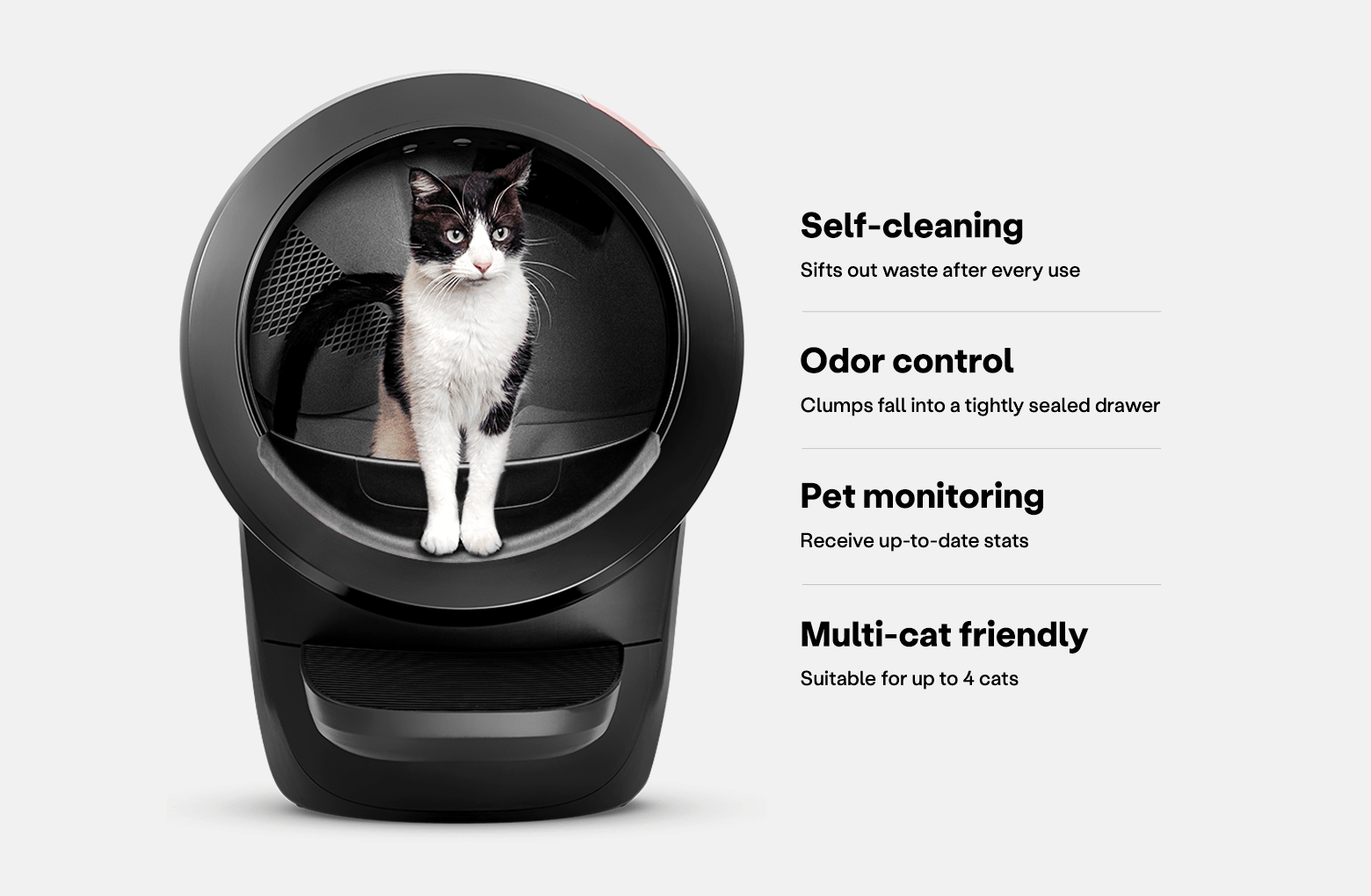
The ScoopFree is the best option for single-cat owners who want the absolute least maintenance. For multi-cat households, the Litter-Robot 4 is a better choice despite its higher upfront cost.
Ongoing Costs and Tray Refills
The biggest consideration with the ScoopFree is the ongoing cost of replacement trays. Here is a realistic cost breakdown:
- Tray replacement frequency: Every 3-4 weeks for one cat, every 1-2 weeks for two cats
- Annual tray cost (one cat): Approximately 13-17 trays per year
- Comparison: Premium clumping litter for one cat typically costs less annually than the ScoopFree tray system
The ScoopFree is a convenience premium, not a cost savings. You are paying for the time and hassle saved by not scooping daily. For many cat owners, that tradeoff is absolutely worth it.
Tips for Best Results
- Place a litter mat underneath. Crystal litter tracks aggressively — a good mat catches 80% of stray beads.
- Stir the crystals weekly. Gently mixing the crystals distributes moisture more evenly and extends tray life by several days.
- Swap trays proactively. Do not wait until you smell something — swap at the 3-week mark for best odor control.
- Keep the area ventilated. Crystal litter works by absorbing and slowly evaporating moisture. Good airflow helps this process.
- Transition gradually. If your cat is used to clay litter, place the ScoopFree next to their old box for a week before removing the old one.
PetSafe ScoopFree Review: Final Verdict
So where does this PetSafe ScoopFree review land? It delivers on its core promise: dramatically less litter maintenance with excellent odor control that genuinely surprises many pet parents. You will realistically get 22-26 days per tray for one cat — and compared to daily scooping, that is a life-changing upgrade that earns a strong recommendation.
The tradeoffs are worth noting — ongoing tray costs and crystal tracking — but they are minor compared to the daily time and hassle you save. For single-cat households, the ScoopFree genuinely makes litter box duty almost disappear. Final Verdict: 9.0/10
Comparing self-cleaning litter boxes? See our Litter-Robot 4 review for the premium multi-cat option, or browse our cat supplies for more recommendations.
Frequently Asked Questions
Can you use regular clumping litter in the ScoopFree?
No. The ScoopFree is designed exclusively for PetSafe crystal litter trays. The rake mechanism and tray design are calibrated for crystal litter. Using clumping clay would jam the rake and void the warranty.
Does the ScoopFree work for multiple cats?
Technically yes, but tray life drops dramatically — expect 1-2 weeks instead of 3-4 weeks, doubling or tripling your ongoing tray costs. For multi-cat households, a Litter-Robot or traditional litter with daily scooping is more practical and cost-effective.
Is crystal litter safe for cats?
Yes. Crystal litter is made from silica gel, which is non-toxic and non-clumping. It has been used safely in cat litter for decades. It does not produce the silica dust that some clay litters do. However, if your cat is prone to eating litter (pica behavior), consult your vet before switching to crystals.
How do you dispose of used ScoopFree trays?
Simply slide the used tray out of the unit, place the included lid on top, and dispose in your regular trash. The trays are fully sealed with a plastic liner, so there is no mess. Crystal litter should not be flushed — always dispose in trash.
Does the ScoopFree rake scare cats?
The rake activates 20 minutes after your cat leaves the box, so your cat is long gone by the time it moves. The motor is relatively quiet. Based on pet parent feedback, cats show no signs of being disturbed by the rake — most adjust within the first day.